My Husband Became a Writer. It Changed How I Write.
Simul-published on my new Substack: The Deep Current
Lately, Harrison has been reading his new work aloud. It’s very intimate. He has read to his mother, to friends gathered around a table on Martha’s Vineyard, to me, and to other people he trusts. He reads drafts aloud to see what works and what doesn’t. He makes notes. Then he goes back to the draft. I sit there beaming (usually tearing up with pride).
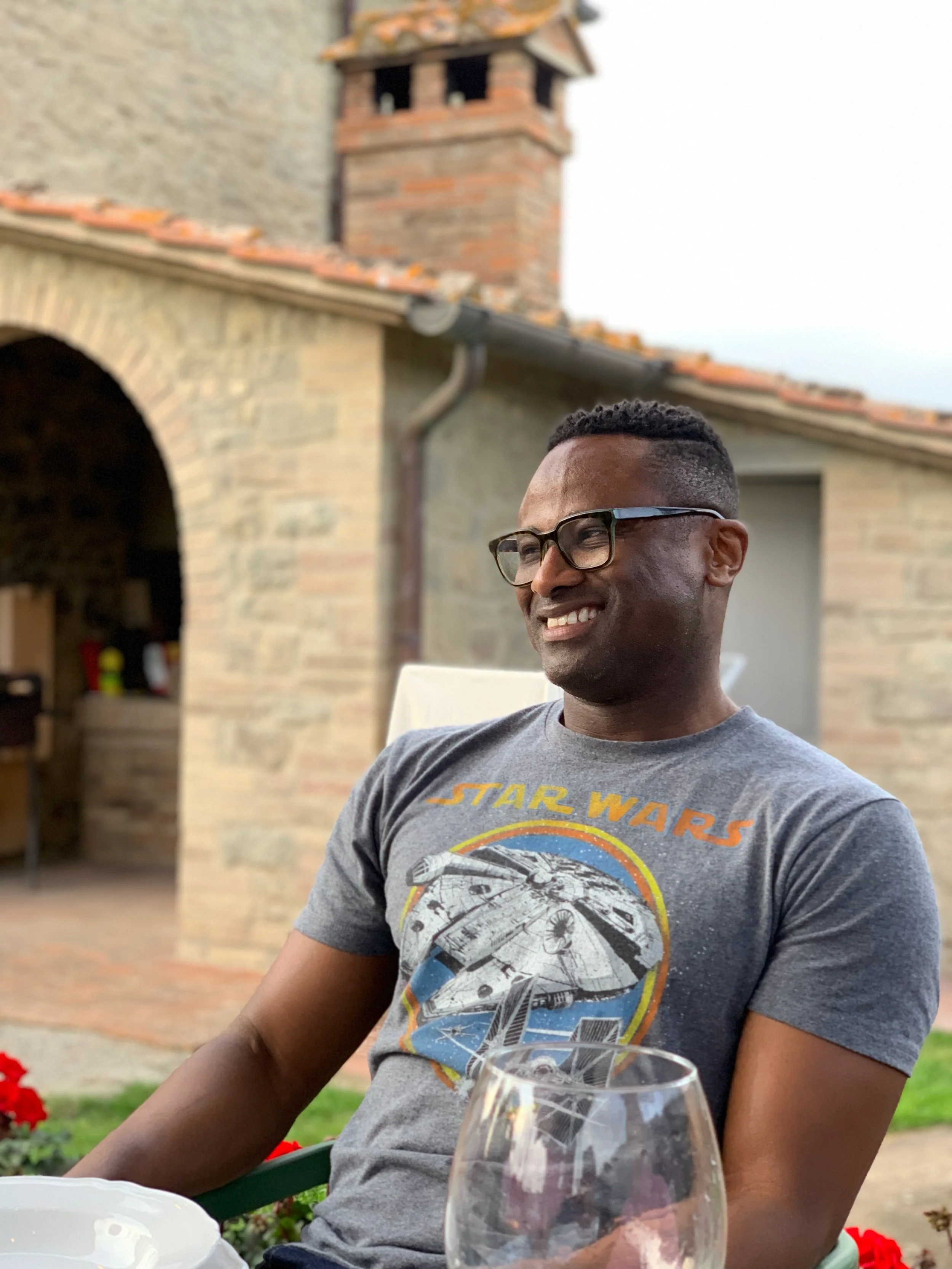
Harrison has always moved through life with a remarkable appetite for trying new things. He has taken improv classes and boxing lessons. He ran a Tough Mudder. He has talked seriously about becoming a sommelier, booked himself onto a yoga retreat in Provincetown, and imagined hosting listening nights in our apartment built around the albums and artists he loves. He can settle into an almost impossibly chill rhythm when we travel, spend an evening deep in conversation over a smooth cigar, lose himself in a great drag performance, and still become a dancing legend when the right song comes on.
He approaches life with a fierceness that I admire. When something piques his interest, he tries it. So, he joined a creative writing group at our local community college in Minneapolis three years ago, maybe a little more, and has been writing ever since.
His writing is deeply personal. He is working toward a book for our daughter, Genhi, about the three women who taught him how to live and the little one who taught him how to thrive. He writes from his memories, returning to people and moments he has carried for years, sometimes revealing parts of himself he had previously kept hidden. His mind is able to retrieve a specific detail from decades ago and write about it as if it happened yesterday. It’s infuriating when we argue, but admirable when he writes.
He has also made remarkable friends because of his writing. I’m talking about you, Suni! He reads drafts aloud. He listens. He revises. Then he revises again. Harrison does not settle. That is the part of his practice that I admire most.
My own writing practice has developed very differently. Something big catches me. A system that does not make sense. A tax code I can’t square with its purpose. Contradictions between what we say we value and how we behave. Even when I know the argument I want to make, I don’t always know where the essay will end up. I work through ideas in dialogue, going back and forth until the argument gets sharper and finally something interesting emerges.
I have always wanted to be a good writer and reading has brought a particular joy. I am proud of the private library we have collected at home, and that Genhi loves reading, too. I am drawn to stories that introduce me to other cultures as well as to biographies. James Baldwin. George Michael. I have never been interested in self-help books. I think the habit of looking under the surface shows up in my own writing.
In My Inheritance, for example, I began with my father’s death and his funeral. As I wrote, I found myself holding two truths together: my father was deeply good and deeply flawed.
In Love the Artist, Not the Logo, I was frustrated by how often cultural institutions are treated as the thing worth preserving while the artists remain in flux.
In The Next Right Thing, I thought I was writing about Sundance and how much I missed that chapter of my life. It turned out that my memories were preventing me from moving forward.
I keep looking for the thing underneath the thing. It is why I called this place The Deep Current.
Watching Harrison stay with a piece longer than I usually do has made me question my own impulse to publish once I understand the argument. My impulses are different. I work quickly, seeing patterns, connecting things that may not appear related at first. But speed can sometimes mean publishing too soon. Watching Harrison work has reminded me that the next draft needs more of me. More details. More vulnerability.
I do not want to write like Harrison, though. Our minds do not work the same way, and I am glad they do not. His mind is a filing cabinet in a room bursting with more filing cabinets. Mine is a drafting table with three futures sketched on it at once. He can return to something that happened 35 years ago and find the detail that makes the memory potent again. I look at what exists now and imagine what it could become.
When Harrison started The Little Roar, I realized I wanted a new place for my writing, too. I had resisted Substack for a simple reason. I did not want to decide that I now owed the world a newsletter every Thursday morning. I still don’t. I will write when I have something to say. That may be once a month and it may mean there are stretches when I publish nothing at all.
Substack makes you, my readers, visible. Subscribers. Likes. Restacks. Comments. That visibility can be tempting, because it is very easy to check whether a piece is hitting well instead of asking whether it says what I wanted it to say. My personal website protected me from some of that. I published essays there and then shared them via email, LinkedIn and Instagram. I was not exactly hiding under a bushel.
I’ve now created The Deep Current as a place to bring some of my previous essays back. Not everything I have written deserves another chance in the spotlight, but I am still grappling with many of their ideas. I hope someone might read the collection and understand what I care about, how I think and the kinds of questions I grapple with. Perhaps someday that person will want me in a room where something interesting is being imagined.
Imagining what might come next is something I know how to do. For much of the last six years, that has been both a gift and a curse. Before the pandemic, Harrison and I were living in Boerum Hill in a two-story townhouse with a backyard I invested a great deal of time and effort in. We were making more money than we ever had. We traveled abroad often and we were out more nights than we were in. Genhi had unexpectedly found her way into our lives, and suddenly we were parents, walking her to the Chinese preschool in our neighborhood and trying to understand how this beautiful new family of ours was going to work.
Then the pandemic arrived. I was laid off and we moved back to Minneapolis. The life we had been living did not simply pause. It ended. Yes, we were healthy. We had a beautiful home. We had each other. We were not facing the kinds of losses that millions of people did. Still, unemployment affected me deeply. Unemployment led to doubt. Doubt led to anger. Anger led to reinvention.
I do not mean that suffering was somehow necessary or deserved. I mean that the disruption forced me to confront parts of myself I had been able to avoid when everything was working. What did I actually value when the professional identity no longer defined me?
Life now contains much of what I once said I wanted. I live back in New York City. I have work with purpose. I have meaningful experiences with friends. I have Harrison and Genhi. I have a life that is full. And still, part of me is always envisioning another version. More financial freedom. More community. More travel. More ease. Some future configuration in which everything finally clicks into place and I have arrived. (I should write about this discontent someday…)
At the Ibsen Scope Festival last May, I talked about civilization not as something that happens to us, but as something we create every day through our choices, our relationships and our spaces. Things happen to us, though. Jobs disappear. People die. Finances change. Institutions fail. Plans collapse.
I did not choose the pandemic, the layoff or the disruption that followed. I can choose how I respond, though. I can keep moving, change direction, rethink what really matters and make decisions that bring our life closer to what we want it to be. It's the same instinct I bring to my writing: look closely at what exists, ask why it exists that way, then imagine something else.
I want to borrow some of Harrison’s patience. It is the same patience I have seen in the most interesting artists I’ve worked with. They stay with the work long enough for something deeper to reveal itself. I want more of that in my own practice, to remain with an essay after the argument has been made and to be more vulnerable.
After 23+ years together, Harrison continues to surprise me. I am proud of the writer he is becoming, but even more grateful that watching him has made me take my own practice more seriously.
Welcome to The Deep Current.