Poets on the Payroll
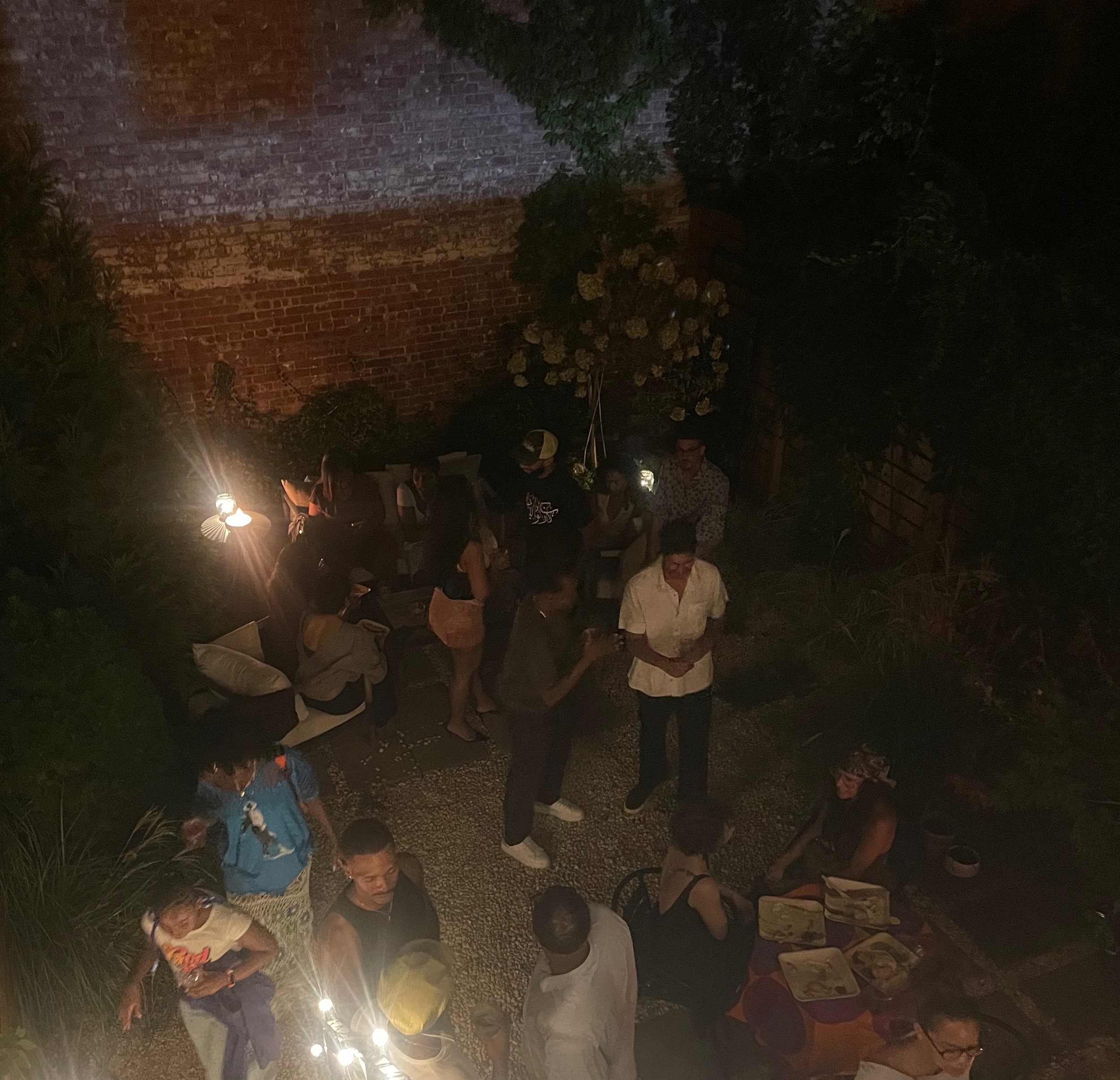
One Sunday night recently, I was invited to Kickback, Vol. 3 in Stuyvesant Heights by a friend I hadn’t seen in quite a while. The Partiful invite left little clue what was in store except “Good Drink. Good Tunes. Good Vibes.”
Sooo Brooklyn.
It had already been a full weekend and I wasn’t sure that I was in the mood to go, but I really wanted to see the host. So, I put on what I thought was a cool-fit and headed out. I’ve known the host off and on for over 20 years, and as I boarded the train, I thought back to meeting him all those years ago on the mountain in Utah. I thought about how much I’ve enjoyed watching his star rise as an actor in theater, film and TV. It was a perfect summer evening as I walked through his quiet (clean) Brooklyn neighborhood, secretly wishing it was ours’, too. I showed up on time (as I always do) and clay bowls of glimmering candles welcomed me up the stoop.
I let myself in the front door with the typical jitters of arriving somewhere alone, assumed the role of a confident person and started introducing myself to the smattering of other early-arriving guests (it was 30-minutes after the stated start time btw). Soon, though, I met a poet who oversees “brand” for a technology company. We fell into surprisingly meaningful conversation rather quickly, skipping the surface talk that usually takes up the first part of any party banter. We dove into a back-and-forth about the effect that AI is having on workers inside tech companies.
I admit that I haven’t really given any thought to the impact AI is having on these specific workers. It seems the sky is falling for nearly everyone else who works with human beings like I do in arts and culture. But, keeping an open mind, I kept listening. I learned that some of the people who have built careers in the tech sector have discovered that fewer people are needed to do what once required entire teams. Coders. Engineers. Designers. So, now what happens to them? These are often people who like making things, solving problems, pulling systems apart, obsessing over how something works. Nerds and geeks, the poet said affectionately. And then she posited that some of them might be pointed toward more creative work as their lives are unraveling. Might this disruption produce a new appetite for making things in the physical world, for writing, performing, learning an instrument, working with paint or fabric, being together?
I’m not sure, but it makes me think about the adaptation that is a part of a creative’s daily existence.
I have linked risk and creativity together for a long time. We regularly spoke about risk at Sundance. In fact, I think it was one of our core values. Years ago, I was talking with my dad and trying desperately, as I often did, to find a bridge between his life and mine. He was a farmer in rural Iowa and I was a creative in some big city on one of the coasts. During one of these chats, I made the observation to him that we were actually in the same business. We were both gamblers. As he looked skeptically at me, I continued.
He planted corn and soybeans in April without knowing what the weather in July would do. He studied conditions, he understood the land, he watched the markets, he drew on years of experience and made informed choices. Despite all that, he still could not control whether it rained or hailed or how commodities would trade on the stock exchange once the harvest came in. He could not stop a tornado, like the one that destroyed our family farm on a steamy July night in 1981. He, like all farmers, lived with ambiguity and risk.
I can relate to that. My “crops” are projects, artists, organizations… and ideas. I gather people. I design moments. I imagine new systems. I envision something that does not fully exist (yet). Then I discover whether it will matter, whether the idea works, whether it changes anything, whether what I imagined resembles the thing I eventually make. Loads of ambiguity and risk.
This isn’t reckless, though. And it wasn’t for my dad, either.
My dad didn’t go out into the Iowa cornfield on a random day and scatter seeds. Likewise, I don’t have an idea and all of sudden it’s brilliant. Both practices require rigor, years of accumulated knowledge and an ability to decipher between what we can manipulate and what we cannot. And, we possess(ed) an unusual tolerance for uncertainty.
Maybe every company needs a farmer on its payroll. Maybe it needs a poet, too.
I’ve worked in Corporate America a little bit over the years and each day, I sit with my husband and our eye-rolling 10-year old daughter around the dinner table while he regales us with stories about his day in the halls of Metropolis. I’ve learned about forecasting, modeling, mitigating, optimizing, taking any possible risk off the table. In my own work, I’ve been trying furiously to get a bridge loan for HB Studio, and it’s remarkable how risk-averse lenders are even when there’s a proverbial pot-o-gold at the end of the rainbow.
Artists don’t have the luxury of certainty.
Many artists, including myself, have lived without predictable or adequate income (grimace). We make work before funding arrives. We work for too little pay. We bring together elements that were never designed to fit together because we see something special. We take ordinary materials and see something else inside them. We think abstractly. We are highly irrational people sometimes. I love that about us.
I am not saying that artists are better people. I am saying, though, that being an artist develops particular muscles.
While I served on the National Advisory Board for Creative Capital, I championed an investment model designed for artistic risk. This organization views experimentation as an asset worth supporting.
Creative capital.
We are comfortable calling money capital. We talk about political capital and social capital. We understand that time is valuable. We financially reward institutional knowledge, relationships, experience and tenure as assets. Corporations describe employees as human capital.
Why shouldn’t we consider creativity the same way?
I’m not talking about putting a price on Merik Goma’s next piece or calculating how much revenue Oh, Mary! generates for restaurants and hotels. There are plenty of economic impact reports that have done this over the years. Those reports haven’t really moved the needle, have they? I mean something different.

Merik Goma
As I Wait, Untitled #6 (Bread and Roses), 2019
C-print
40 x 60 inches
Creativity itself as an Asset.
A number of years ago I had the pleasure of working with colleagues at IDEO. Our collaboration started casually, over coffees and lunches, as we got to know one another. Our conversations became brainstorms and, eventually, Creative Tensions emerged, a format for helping groups engage with big, impossible questions that IDEO continues to use today. But it’s not the format I am most proud of. I am proud of how I now think differently because I met those fabulous design-thinkers. I learned from the way they approached their work:
begin with people rather than predetermined answers
turn ideas into prototypes quickly
test them without defensiveness, and
treat revision as a joyful practice rather than failure.
We had so much fun creating together and we learned a lot through the act of making. This brings me back to the poet I met at the party.
As she was imagining displaced tech workers moving toward creative practice, I proposed that maybe companies need more artists inside them. Take almost any corporate values statement and Innovation is mentioned front and center. Also Curiosity and Agility and Being Bold. But the people who spend their lives actually practicing those things are never in the room. They want creativity without necessarily wanting artists who know how to do those fucking things! Hmmmm…
The hypocrisy is so obvious to me and relates to the non-profit sector, too. We are constantly told that we need bankers, lawyers and business executives on our boards. Somehow, their collective knowledge has more value in running a museum and a theatre company, even if they have no idea how a rehearsal room works or how a curator puts a show together. It’s just assumed that they are better at the decision-making table.
Side Note: I know a lot of good attorneys and doctors and bankers who get it, by the way - we need you!
Now, suggest that a poet join the board of corporation because she understands beauty, nuance, humanity and has an economy with words. Suggest that a painter sit in a strategy session because he has spent a lifetime learning to see what others miss. Suggest that an actor participate in a governance conversation because they understand collaboration, interpretation and the difference between what people say and what they mean (Hello, Uta Hagen).
Watch how quickly people start to squirm. LOL.
The artist is welcome when everyone needs a good story, the campaign needs content or the event needs a performance. “Make something beautiful. Make us look cool. Then leave the room while we do the real work.”
Artists know how to work collaboratively because most art forms require working with other people. We know what we make will become better when made in community with others. We have spent our lives making things from very little and we still continue to work without guarantees. In an economy built for automation and efficiency, these skills may become more valuable. Don’t you think?
AI is a remarkable tool. I use it. I seriously don’t think I could do my job at HB without it. Especially without an Executive Assistant or someone to help manage the Board. I use it to improve systems by identifying patterns and making better processes. I truly love how it helps me and it’s extraordinary. I do worry, though, about a world where everything works beautifully, but feels the same. The same language. The same solutions. The same aesthetic. The same messages fed back to us.
Artists are needed in a world with AI.
A world with diverse stories, forms, points of view and ways of seeing is simply a more interesting world. It is a world with more meaning. I think this would matter for Big Tech and Corporate America, too, because standing out matters from one’s competitors. I think it also matters for society because human beings need more than efficiency. We need a lifeline to something real. So when I say Creativity is Capital, I’m not proposing another metaphor. I’m proposing something super tangible.
Perhaps we should put a line item for creativity in our budgets. I do not know yet exactly what that would look like. I don’t need to know yet. But, we do need experimentation. And artists know how to experiment.
Put the poet on the payroll.