My mother, my brother, my sister and I sat beneath fluorescent lights in the ICU waiting for updates after my father’s recent farming accident. We waited for scans. For MRIs. For hourly nurse visits. For examinations by skilled neurosurgeons who spoke in measured tones about swelling and pressure and eventualities. We waited for language that might tell us whether he would come back to us as himself.
He would not.
For decades my father lowered his center of gravity when the weather rolled in. He was steady in crisis. He rebuilt after storms. He kept moving when markets tightened, when hail came and when machinery failed. Now we were the ones scanning monitors, reading numbers, trying to interpret signs. Now we were the ones making decisions that felt impossible.
We were about to make choices for a man who had rarely allowed me into his interior life. I knew his convictions. I knew his theology. I did not know his doubts. I did not know his private fears. I did not know what he would say in this moment beyond the Bible verses he had quoted his entire life. In that hospital room, the public man and the private dad began to distinguish in my mind.
Three hundred-fifteen people came to the visitation. The line wound through the church sanctuary and into the hallway, folding back on itself in the way small towns do when grief and friendship converge. My family and I stood for four hours receiving hugs and stories about my dad. He showed up. He fixed things. He gave steady advice. He was dependable. He was good. To a person, that was the word they chose. And I believe them.
He was good to many people. The rural Iowa/Minnesota community that formed him loved him deeply. His large extended family loved him. His faith communities loved him. He occupied that world fully… and it affirmed him in return. Listening to story after story of his generosity, I felt pride. I also felt something more complicated in me. A tension between the public goodness being celebrated and the private fracture I have carried for much of my adult life.
It would be easy, in the face of that much collective affirmation, to let my own history with my dad soften at the edges. To allow the dominant narrative to carry the day. But dignity requires honesty. I do not want to rewrite anyone else’s experience of my father. Their love is real and their gratitude is real. And so is my story.
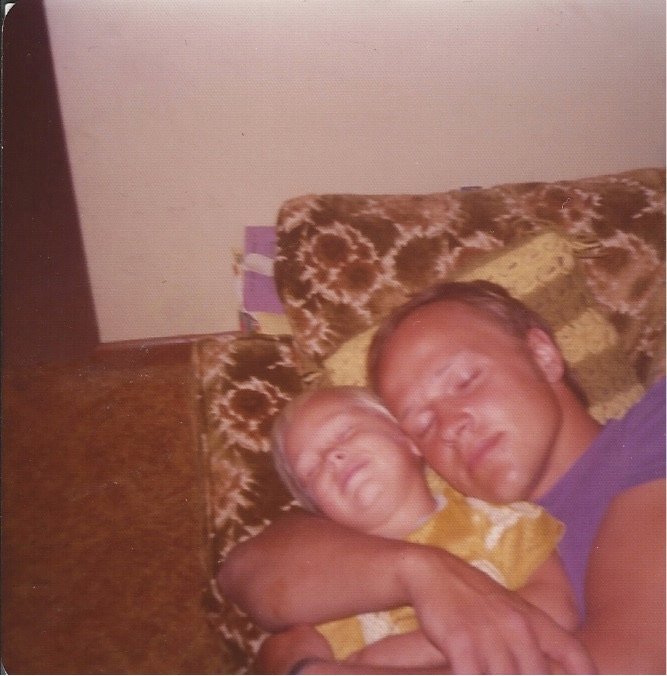
My childhood was, in many ways, happy. I do not recall early hardship. I remember a vast extended family on both sides, uncles and aunts whose lives were braided together through church, planting/harvest and meals. I remember a farm that felt permanent even when markets and weather suggested otherwise. Our house was ordered by rhythm and belief. We went to church three times a week. There were daily devotions at the table, delivered by my father. Always the male voice leading. Faith was not in the background.
Certainty was prized. Doubt was not part of our conversation. And beneath that certainty there was fear, though it was rarely named as such. Fear of Catholics. Fear of the end times. Fear of Hollywood. Fear of the “other.” Fear of difference in almost any form. There was shame around bodies, around desire, around love that did not fit the prescription. As a child, I absorbed that atmosphere before I had language for it. I learned that belonging came with conditions. I learned to constantly be scanning for lines I might cross without meaning to. To moderate how I showed up all the time.
My father did not invent that world. He inherited it. He believed in it and he upheld it. It gave him clarity and comfort. It gave him a moral framework that explained the world and his place in it. It rooted him in a closed and self-perpetuating society that reinforced itself through repetition and conviction. Within that world, he was respected. Within that world and possibly others, he was good.
But that same world constricted me.
When I say I experienced spiritual abuse, I do not mean spectacle or dramatic scenes. I mean a nervous system shaped by vigilance. I mean learning early that everything was moral. Movies were moral. Music was moral. Politics were moral. Bodies were moral. Love was moral. The air itself carried judgment. It makes sense that I now experience questions of belonging and exclusion as ethical questions. I was trained that way. I have simply chosen a different direction.
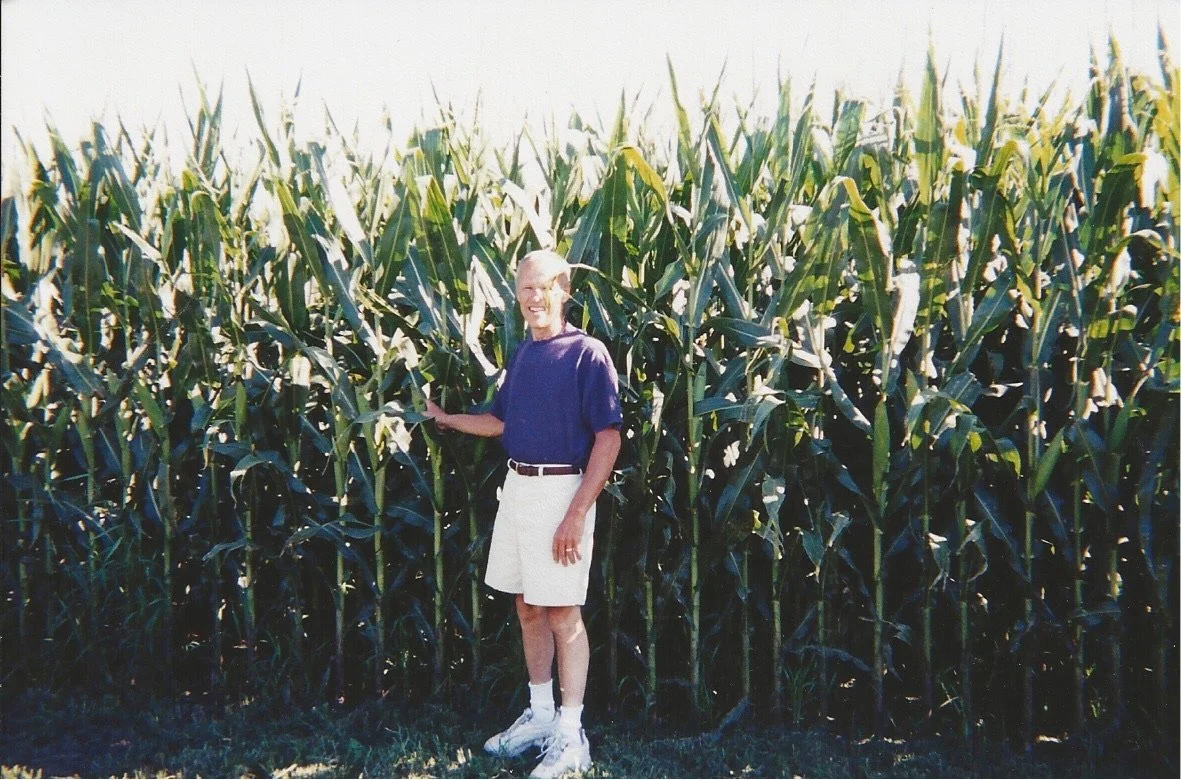
There were gifts, too. My father loved farming with a devotion that bordered on reverence. He could talk about soil and seed, machinery and weather, with a level of detail that revealed how deeply he was attuned to the land. Farming is a gamble disguised as routine (something I share as a creative in my own career). You prepare the soil. You plant. You watch the sky. You wait. He understood that you cannot command the weather, only respond to it. During planting and harvest, we would not see him for weeks. The work consumed him. Then winter would come, and with it long hours in his recliner, a book in his hands, the fields resting under snow.
In the late 1980s, when the Farm Crisis rippled through rural communities and he had to take on another job, I do not remember hardship. I remember him continuing. The land mattered. Work mattered. Showing up mattered. That was his love language. At the visitation, I heard that refrain again and again. He showed up.
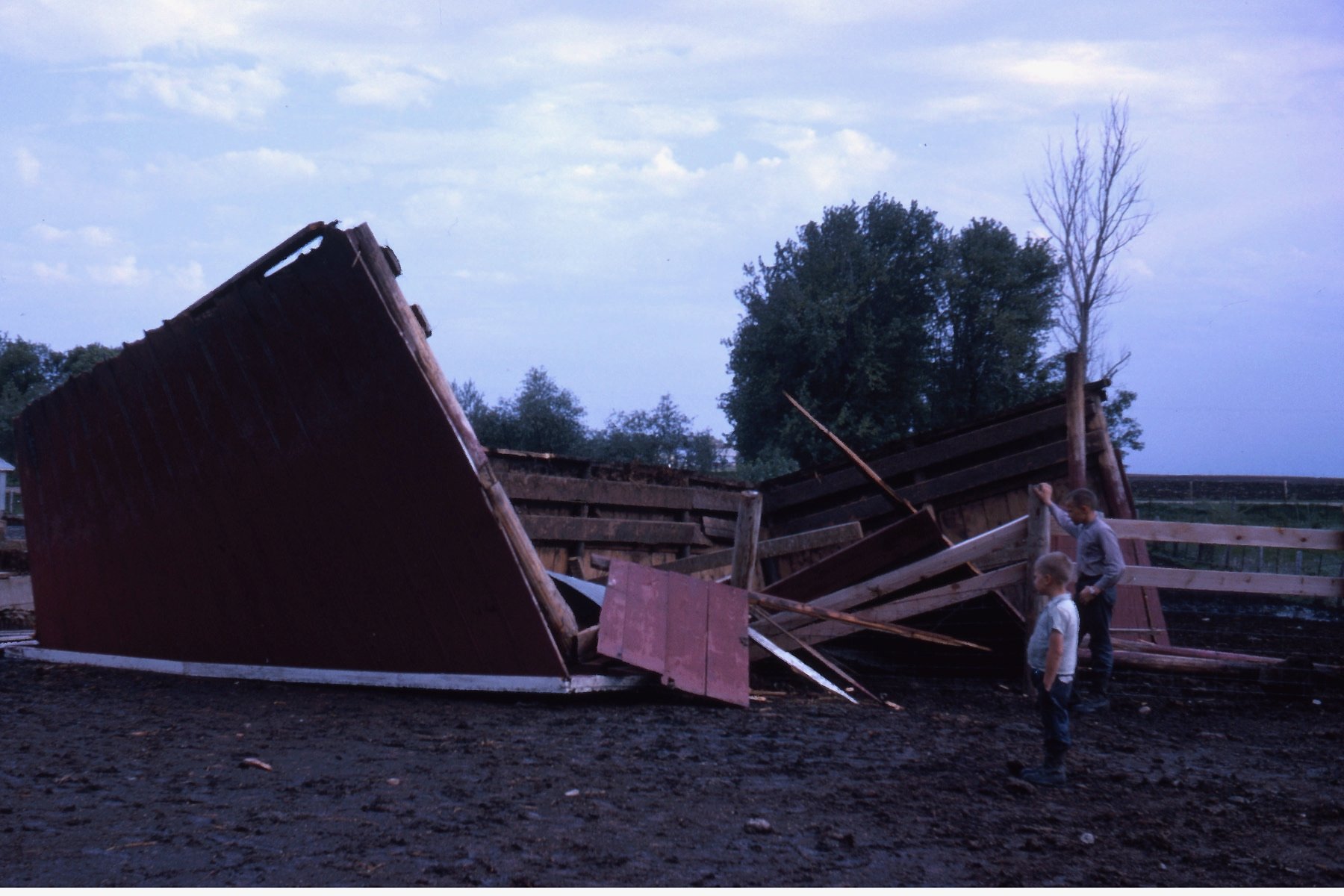
Observing the tornado’s effects
One of my clearest childhood memories is the early morning a tornado hit our farm in the summer of 1981. I was eight years old. The air had been thick and restless all evening. He woke his young family and moved us downstairs before the worst of it hit. He wasn’t frantic. He was decisive and calm. My child brain remembers the thunderous sound, the pressure, the green color of the sky, the eerie quiet that follows destruction. In the early morning hours, still in our pajamas, he drove us to my grandmother’s house. Then he turned the car around and went back alone to begin rebuilding.
I don’t want to turn that night into a metaphor for everything. It was one event among many. But it reveals something essential about him. When the world shifted, he put his head down and began again. What I carry from him is that groundedness. A respect for forces larger than myself. A sense that when something breaks, you keep moving. That inheritance runs deeper in me than I sometimes realize. We found occasional common ground in small things. Landscaping. Tending the yard and mowing the many acres of grass in straight lines. There was satisfaction in shaping what was visible and contained. But as I grew older, our differences widened.
I once asked for a ten-speed bike and remember him scoffing, skeptical that I would actually ride it. He was practical. He was cautious. He was present in tangible ways. He did attend my piano recitals and drove in arctic temperatures to the first play I directed in college.
Until I came out.
After I came out, something changed. He avoided me and struggled to have a conversation about my life. He could not accept my own family, even after my husband and I had been together for more than two decades. He tried, in small and inconsistent ways. He showed up occasionally. But not as he did for my siblings.
The first time he met my husband was not at the family home. It was in a park, away from the gaze of his community that might question. That decision did not negate love, but it defined its limits. He traveled across the world to visit my sister and her family in Thailand. He never made it to New York City to see mine. What saddens me most is not that he disagreed with me. It is that he couldn’t allow himself to fully step into the bounty of who we are. He just stood close to it. He never quite entered, though. His world was already rich in many ways. It could have been wider still.
Standing at the funeral, I felt my stomach churn more than once. Not because people were grieving him, but because the world he inhabited so fully still hums beneath the surface of casual conversation. A silly, passing criticism of Mamdani. A familiar reflex that treats certain voices as suspect, especially divorced ones. I recognized the pattern instantly. The same moral architecture that labels Democrats or Muslims or difference itself as dangerous still operates quietly. It is not abstract for me. It shaped my childhood. It shaped the limits of my relationship with my father.
And then, in another setting a few days earlier, a hospital worker met my eyes and offered a subtle thumbs up at the kaffiyeh I wear. No speech. No debate. Just recognition. That, too, is moral. That, too, is a choice about belonging. These gestures are small, but they reveal the worlds we are building.
Everything feels moral to me because so much was moralized in the world that formed me. My father believed he was defending goodness. I believe I am widening it. The urgency in both of us may not be so different. The horizon is. I realize now that much of the work I have devoted my life to (building spaces where people can question, experiment and belong without shrinking) did not emerge from nowhere. It is a response to the world that formed me. I learned early how powerful closed systems can be, how they reward conformity and guard their boundaries. I also learned what it feels like to stand just outside those boundaries. The widening I pursue now is personal.
I do not feel anger toward him, but I do feel sadness. Sadness that we never developed the kind of intimacy that would have allowed him to show me his interior life. Sadness that scripture so often replaced our real human-to-human conversation. Sadness that fear and certainty fenced him in. Sadness that he never quite stepped into the wider circle that my life has become.
When I picture him now, I see him in that recliner, a book in his hands, the fields resting outside. From the outside, he looked content with the smallness of life. I do not know if he was. Perhaps those boundaries felt like peace to him. Perhaps they felt safe. I will never know. He did not open that part of himself to me.
Public goodness and private fracture can coexist. Love and exclusion can coexist. Faith and harm can coexist. My relationship with him held all of that complexity. I am not rejecting him, though. I am revising my inheritance. I am carrying forward the groundedness, the respect for land and labor, the discipline to stay with hard things. I am correcting the fear, the rigidity, the narrowing of belonging. In my own life, that revision takes the form of building wider tables, asking harder questions, resisting the ease of certainty. Both truths live side-by-side.
And I am choosing to live wide. To hold conviction without fear. To build community without exclusion. To remain grounded without becoming closed. That choice feels moral and urgent to me, not because I am at war with my father, but because I have seen what smallness costs. He may have been content within the boundaries he accepted. I cannot live that way. My life demands something different. I carry him with me, not as a villain… not as a saint… but as a man whose goodness and whose limits both shaped the life I am still learning how to live.
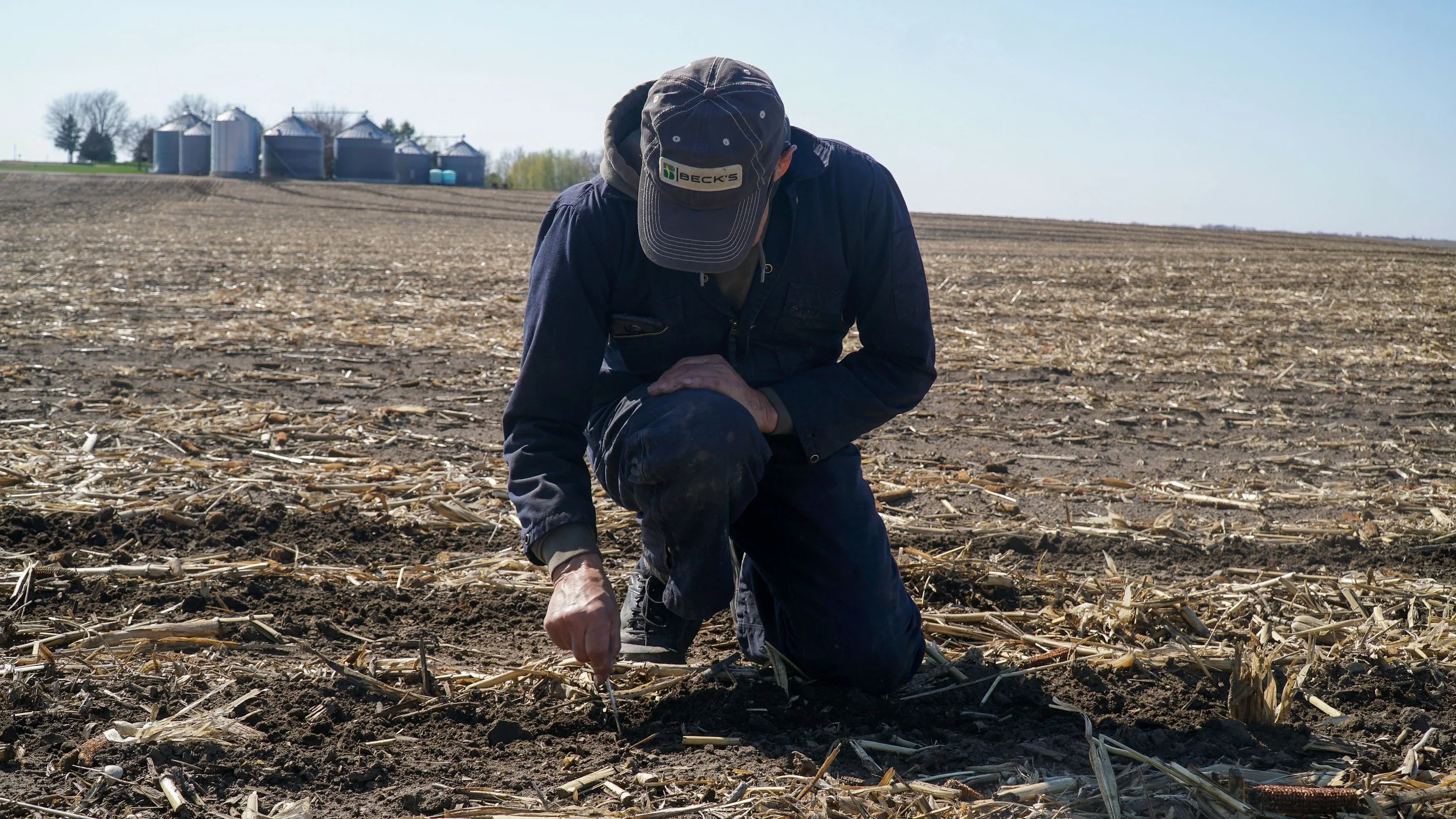
Daniel Ray Hibma (February 20, 1950-February 19, 2026)